

“You’re getting sloppy, Luthor.”
These words open issue 5 of John Byrne’s Man of Steel mini series of 1986, an epic year in comics history which saw a hard reboot of Superman. Byrne draws Superman with a stern look on his face, casually holding a power suit belonging to one of Luthor’s henchmen. Fans will immediately recognize the green and purple armor as having belonged to Lex since George Perez designed it in 1984. And yet here, Byrne inserts a meta commentary that things have now changed radically with his arrival, and the “old shell” of pre-Crisis continuity is being cast aside in favor of the new.
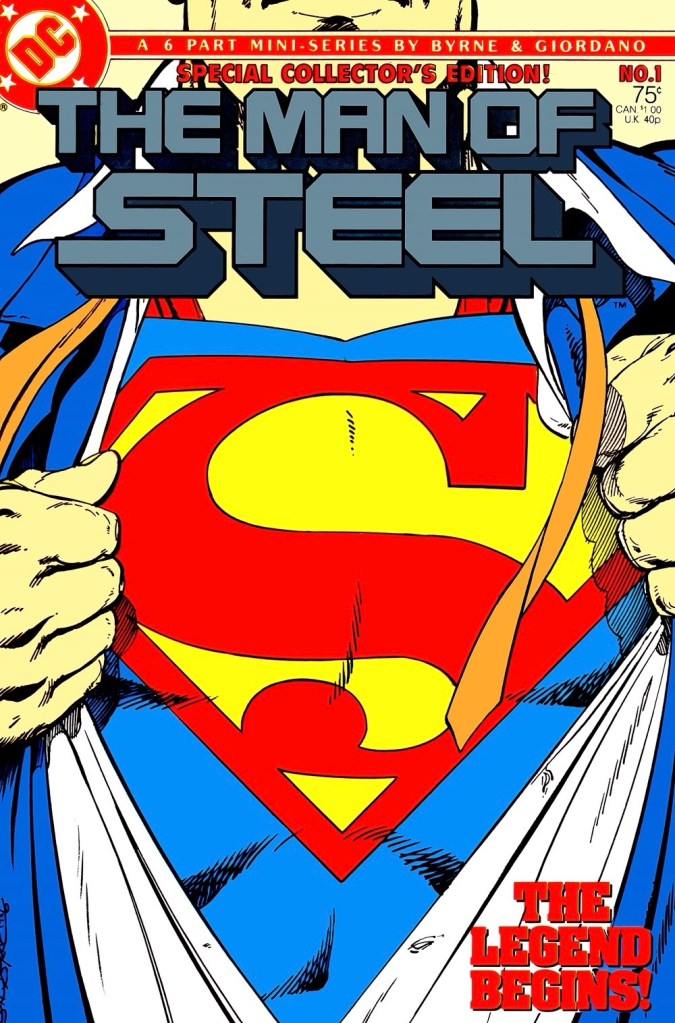
I should pause here and say I wasn’t reading comics in 1986. I did not inhabit Superman’s published world at all pre-Crisis, and didn’t experience the new status quo as a fan who read through that era. I can’t speak to how seismic the changes to Superman were when John Byrne released this miniseries, at least not firsthand. On the contrary, I grew up in the world that immediately followed, which had adopted everything he did, and undid.
Some changes to Superman’s mythos instituted by Byrne in this series are as follow:
– Superman’s power levels are reduced, compared to the Silver Age
– Superman’s parents are alive
– Lex Luthor is an evil businessman
– Clark Kent and Lois Lane are reporters at the Daily Planet
– Superboy never existed
– Lana Lang knows Clark’s secret
– Superman is the only survivor of Krypton’s destruction

Byrne establishes- or in some cases reestablishes- these new aspects in his Superman series, and even has Superman call a representation of the previous status quo “sloppy.” I’ve never read Byrne’s thoughts on pre-Crisis Superman, so maybe it’s a stretch to say this panel is a commentary on any prior creative team, but it certainly served as a message that Superman’s world would now be different.

When I first read this mini about twenty years ago I wasn’t too terribly impressed. I had read other works by Byrne that I thought were better, and frankly other Superman stories that I thought were better. A huge reason for that was because many of the changes I listed above went right over my head. I didn’t realize just how much of Superman’s world that I had taken for granted all started right here.
As the years have gone on, I’ve since read this book four or five more times, as well as many more Superman stories that came before and after it. It works well each time, but my goodness, when you put this book within the character’s historical context, you start to realize how just how radical it was. Each time, I enjoy and appreciate it a little more, not just as a solid “year one” type story, but for kicking off a new era for the Man of Steel.

As for the stories themselves, they really are great work on a lot of levels. Art wise, this was Byrne at his peak in the mid-eighties, more refined than the ‘70s but not as sloppy and rushed-looking as the ‘90s or 2000s. Byrne was enjoying his career at this point, and the inks by Dick Giordano gave a nice, distinct, vaguely Neal Adams feel to Byrne’s work at his new employer. The panels go back and forth from big action, to epic splashes, to good character moments. The new designs on old characters (the Kryptonians, Luthor and Bizarro spring to mind) demonstrate genuine creativity.
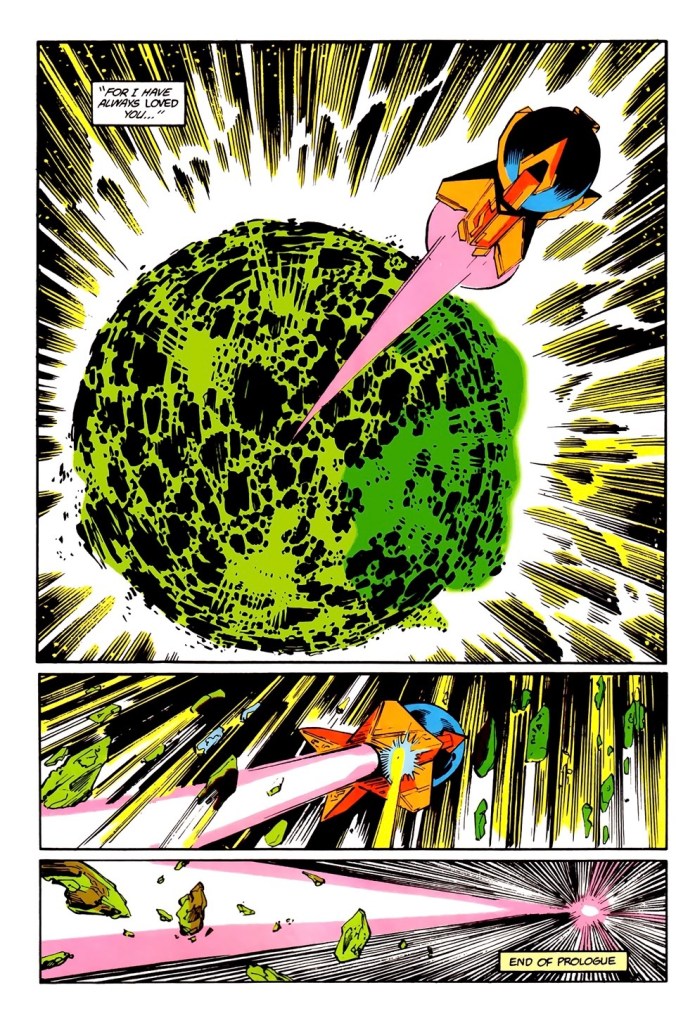
There is a slight corniness to all of Byrne’s writing, which may have been somewhat intentional to bridge this new era of Superman to the older, and many of his characters “sound” the same, but overall it is great as well. Byrne highlights a different aspect of Supes’ world with each issue, and weaves them together to create a new tapestry that the DC Universe and other creators would draw from for years. The six issues impressively take place over five-ish years, but can be read as stand alones or one overall story.

There is so much good that was done by Byrne here, and a lot of story material came out of Man of Steel (ALL of the Triangle Era, aspects of the Lois and Clark, Krypton, and Smallville TV shows, the Ruby-Spears cartoon, etc). If there’s one contribution above all others that this miniseries gives us for Superman, however, for me it is the grounding of the character and his world. So many Silver and Bronze Age stories were just over the top and ridiculous- which, admittedly, is a lot of the charm for many readers, I get that- but when it goes overboard and the reader has to stretch too far to suspend disbelief, it can be an obstacle for many fans. Half-hearted attempts were made to power Superman down and bring him back to our level, but never for long and never all the way.
Man, is it nice to have a Superman who lives in a world without super pets.

After this recent reread, I’ve also come to the conclusion that Man of Steel is a good first Superman book to give someone on the ground floor. In our day and age of graphic novels and collections, Byrne’s Man of Steel was ahead of its day in making sure it was something new or old fans, hardcore or casual could enjoy. This is not something that is easy to do, especially with a difficult character like Superman.

Each one of these six stories is great and offers the reader something new for Superman. It’s amazing to think Byrne’s design for Krypton, which he premiered in this mini, is still being used today, or that one of the best Lois Lane stories ever would be included in this new origin, but the author makes it look easy. The series reads well on a number of levels. It is an awesome story, which I have come to love a great deal.
Readers can look at Man of Steel as a graphic novel, which is fantastic in its own right, or as a cultural moment. If the former, I think anyone interested in the character would be able to enjoy it. If the latter, than this book was nothing less than epic, and one of the biggest moments in the character’s already long and distinguished history.
A great story!
 Niko's Superman Page