
With the recent announcement that James Gunn intends to have his DCU under one umbrella while allowing for an “Elseworlds” line of imaginary stories, I thought it might be a good time to mention my personal favorite Superman Elseworlds stories.
Of all the DC characters, Superman is perhaps the easiest to fit into a “what if?” format, mostly because all a writer has to do is imagine Baby Kal-El’s rocket ship landing… somewhere else. There are exceptions to this of course, and some other absolutely brilliant concepts that can become Superman Elseworlds stories, and overall there are a lot of fun, moving stories that can be told in this way.
While always tough to whittle it down to ten, here is my list of my favorites. Enjoy!

10. Superman: The Dark Side
If the purpose of an Elseworlds story is to ask a thought-provoking “What if?,” you can’t do much better than a hypothetical scenario of Kal-El raised on Apokalips. It’s a delicious premise, combining two favorite mythologies among DCU fans with the obvious peril that would come from an evil Superman. While that scenario has been done- and overdone- over the years, this was a good one.
It doesn’t fall into the usual cliches with evil Superman stories (Batman devises a plan to stop him and easily wins, Supes takes over the world but is defeated by a rebellion, Lois Lane dies, etc), and also asks questions that are a strength of good Elseworlds stories. When a familiar character is placed in an unfamiliar setting, we find out more about what makes them who they are. In this case, is it Superman’s nature or nurture that makes him the good hearted hero that he is?
More on that later. A LOT more.
The story is written by the capable John Francis Moore (whatever happened to him, anyway?) and drawn by industry veteran Kieron Dwyer. To be fair, the premise of this story makes you hope for an even grander, more epic tale, and while it ultimately wasn’t that, it was an enjoyable read.
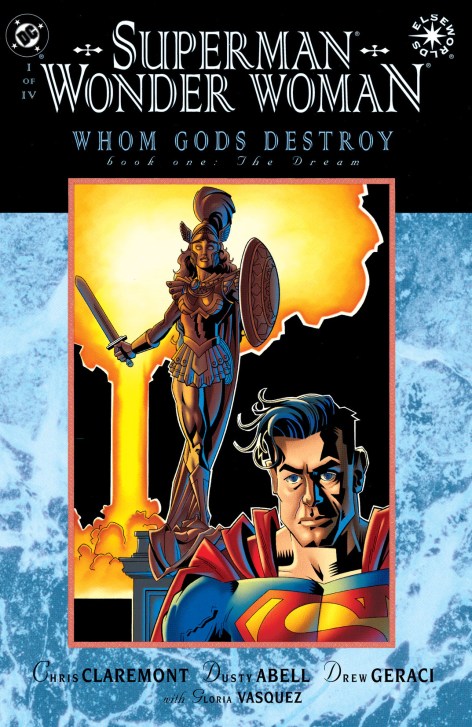
9. Superman/Wonder Woman: Whom Gods Destroy
Chris Claremont is one of the most popular and influential writers in comic book history, and probably the greatest one to come out of the Bronze Age, certainly for Marvel. By the mid-90s, Chris’ Marvel Comics work, highlighted by his 17-year run on the X-books, was behind him, and fans were left wondering what a Claremont story at DC might look like. Enter, “Whom Gods Destroy.”
This story is actually a great premise, about a world in which the Nazis won World War II, and Superman and Wonder Woman, who is actually a transformed Lois Lane, fight to take it back. There are a lot of battles and typical Claremont-isms all along the way, peppered in with a strong dose of Greek mythology, whose themes of godhood and power fit perfectly with visions of ubermensch. It’s told like a Claremont Marvel story, with lots of exposition, dialogue and character introspection, which actually works pretty well for Supes and Lois.
Unfortunately, the story is held back by the terrible art of Dusty Abell, who I’ve seen do much better work than in this story. As a result, the book is a bit incoherent in some places, and along with Chris’ typically packed scripts, does feel like it goes a bit too long.
Still, a solid story and cool concept.
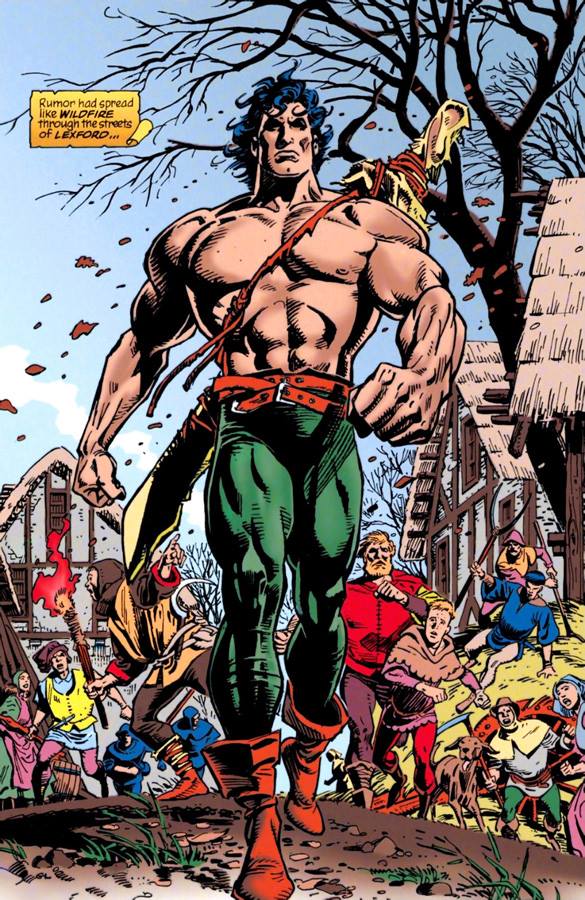
8. Kal
It’s nice to see a steady stream of assignments that DC gave to Jose Luis Garcia-Lopez in the 1990s, after the Crisis reboot relegated a lot of his work to yesterday’s news. He is a very talented artist to this day, and the occasional graphic novel was a perfect place to showcase his stuff.
“Superman: Kal” is a story of Superman and company in Arthurian legend, specifically in a coming of age tale. While the book is written by the very capable Dave Gibbons (whose work as a writer I’d LOVE to see more of today), who gives us many great moments throughout, be forewarned that the book is a tragedy and a bit heavy to read. While not a typical atmosphere for a Superman story, the reason it is heavy is because the writer and artist make us care deeply about the characters. Thus, in this respect, it is an unqualified success.
I enjoyed this book very much, as Gibbons and Garcia-Lopez succeed in showcasing one of Superman’s greatest powers, his strength of heart.

7. Elseworld’s Finest
I just read this story for the first time and really enjoyed it. It’s made by the same creative team as “The Dark Side,” only this time with Superman and Batman in a steampunk/pulp era. Supes and Bats chase a macguffin around the world a la Indiana Jones, while fighting some menacing villains who are trying to reach it first. Super villains showing up when their counterparts team up is a huge plus in books like this, and in this case the two are heavy-hitters Ra’s Al Ghul and Lex Luthor, which makes for some very interesting twists and turns in this story.
Although this book doesn’t knock your socks off like other graphic novels, it’s pretty solid nevertheless. If you like pulp-era adventure or Superman books of the 90s, give this one a try.

6. Speeding Bullets
I see this one show up on a lot of not just Superman Elseworlds lists, but also of Superman stories, in general. While I wouldn’t place it on an all-time Superman list, it is a very good Elseworlds story.
Written by J.M. Dematteis, who always does great character work, it is essentially a story in which Kal-El becomes Batman by living through the death of his parents, this time the Waynes, who found his rocket when he was a baby. Thus, a super powered Batman is born, who fights a Luthor/Joker hybrid baddie.
Hey, a story that combines the two greatest superheroes of all time can’t be bad, right?!
I should point out that this story is drawn by the late, great, Eduardo Barreto, who knew how to tell a story and for me is one of the most underrated artists ever. I’ve lost count of how many stories I enjoy where mid read I stop and ask, “Man, who did the art on this?” only to find it was him. Why he’s not acknowledged in the field more is baffling to me but, then again, fans’ tastes are hard to judge sometimes. In any case, check out this cool story!

5. Red Son
No doubt, there are going to be some readers who right about now are wondering why on earth this book is so low on this list! Well, I outlined my reasons here some time ago, so without rehashing, I just think the over the top, Silver-Agieness of this story knocks it down a few pegs. Some love it, but I was just confused.
All that said, when talking premise, it doesn’t get much better than this for an Elseworlds story. If “and the American Way” was added to Superman’s tagline for the Cold War, what would a Superman be like whose rocket crashed in 1950s Soviet Union? We get an exploration of what “American Way” truly means, as well as the nature vs. nurture argument. This is a sort of quasi evil Superman story, but never veers too far in that direction and is a very satisfying read, overall.
I love Mark Millar writing Superman, and this one is probably his best work on the character. Some would even say it’s one of the greatest Supes stories of all time, and I can see why. He loves the character and his crazy concepts and ideas make for some great places to explore. I’ll definitely be looking out for his upcoming Superman graphic novel next year.

4. Earth One
There was a moment in DC’s history when the Elseworlds brand was retired, and the company started “what if?” stories as original graphic novels for the bookstore market that were under the “Earth One” banner. Releasing Superman first was DC’s best foot forward, and J. Michael Straczynski (whose work on the Superman ongoing was unfortunately cut short due to this) was brought in to write the story with Shane Davis drawing. Superman Earth One Vol.1-3 were high quality graphic novels that read great today, and influenced a lot of what Zack Snyder did in 2013’s “Man of Steel.”
The book is about a young Clark Kent first becoming a superhero and learning about the sacrifice it takes to be one. In this story, Clark is a fish out of water who is weighed down by the loss of his father and navigating his life, as well as thinking about how he will measure up in the world. Overcoming struggles to help others and realize one’s potential are what the best hero stories are about, and when it’s written and drawn well, it’s that much better.
I’ve said in the past that Superman angst stories generally don’t work, but for me a little bit of angst in a young Superman’s journey of self discovery works great here. The action, character moments, flashbacks are all great and never cheesy, and all the OGNs have some good humor sprinkled in as well. JMS had to leave after three books because his eyesight was fast deteriorating, but apparently he’s well again now after a few surgeries. I would love to see him continue this series one day!
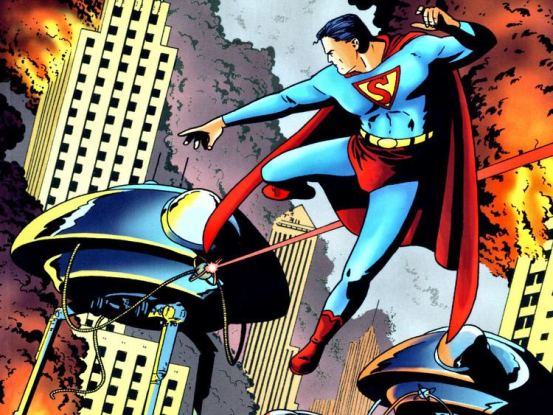
3. War of the Worlds
This one-shot is about the HG Wells classic of the same name and takes place in Metropolis in the 1940s, featuring a fledgling Superman fighting back on humanity’s behalf. The story is fantastic, much like anything written by Roy Thomas about the WWII-era usually is. There are several references to real life events happening concurrently as well as several nods to that era of comics (ie Superman jumps far but doesn’t fly, Daily Star, George Taylor, etc). The art, too, is brilliant, handled by a young Michael Lark, who right away is head and shoulders above most artists of the late ‘90s. His pencils are clean and crisp, and the colors are bright and vibrant.
This story was collected in a recent Superman: Elseworlds volume, which is a great place to read it and I’d highly recommend doing so. It has all the important qualities of a good Superman story- heroism, sacrifice, and a formidable villain, made even more terrifying given Supes’ Golden Age power levels. Personally, I think it deserves a lot more fanfare, as I enjoyed it immensely. Great story, great art, a cool concept… can’t ask for more than that in a comic!

2. Secret Identity
One of the beautiful gifts of storytelling through comics is the ability to get into a character’s head and “hear” their thoughts. Although first person narration is something that has fallen out of favor with some writers today, it was used to perfection by many greats over the years, including Chris Claremont, Frank Miller and Alan Moore. A writer who fully embraces this tool in the medium and who does it better than anyone else today is the writer of this story, Kurt Busiek.
Secret Identity is an Elseworlds story that was published more or less when the multiverse no longer existed in the DCU, and so Busiek did his own take on what the life of Superboy of Earth-Prime might look like. This was a world in which superheroes existed only in published comics, until a young man who is actually named Clark Kent begins exhibiting powers very much like those of Superman himself. The story follows how Clark’s life is radically changed, and treats it by asking questions of how other human beings would react to a real superhuman in their midst, a favorite story angle of the writer’s.

It’s an interesting enough angle by itself, but Busiek’s writing is so good that the reader gets to know young Clark and experience life through his eyes in a very real way, helped all the more by the spectacular art of Stuart Immonen, who here turns in work that is the highlight of his career. It’s no wonder that this story has been in print constantly since it was first released, and has become extremely beloved by fans.
It took me a little while to warm up to this story, as I haven’t really resonated with the “no superheroes in the universe superhero story” as much as others over the years, but the more I’ve read this story over the years, the better it seems to get, like all great stories. There is absolutely nothing like the majestic sites of Clark floating above amazing vistas of planet Earth like we see in this story. If you stop and think about it, these moments are basically wish fulfillment for us as people- the ability to fly and look at life in a different way- and is a huge reason Superman has been such a popular character over the years.
If there is one story that succeeds in celebrating imagination through Superman, a goal of pretty much all superhero stories, it’s this one.

1. Kingdom Come
I mean, how could it possibly be anything else?
I remember going to bookstores in high school and college before I ever owned a collected edition of anything, just to find a copy of Kingdom Come and thumb through it. The concepts and art were mind-blowing, considering that virtually no superheroes had been depicted in serious live-action adaptations up to that point. This is far and away the best work of Alex Ross’ stellar career and one of the greatest comic books ever made. The themes of noble superhero vs. violent anti-hero was perfectly placed in its day, and really spoke to the state of comics in the mid-‘90s.
There’s a case to be made (and often is) that this can be considered THE best comic book storyline of all time. The reason this book is so excellent and a great Superman story is because, for me, the best Superman stories always deal with the question of “what does Superman mean to the world?” A story about an aging Superman who must be convinced to come out of retirement because of his “inability to see himself as the inspiration he is” is incredibly awesome. It’s a perfect vehicle for exploration of him as a character, aided mightily by arguably one of the greatest Superman artists of all time.

As far as Kingdom Come’s status as an Elseworlds story, it succeeds incredibly well on every level. As I mentioned at the start of this post, an Elseworlds story is about placing a familiar character in a very unfamiliar setting, and in doing so really getting to know who that character truly is. When Superman is placed in a hypothetical story in which he has failed to protect Lois Lane and put himself in an emotionally secluded state for years, what happens when he is needed once more? How does he respond? In a battle between his sorrow and his duty as a hero, which one wins? The story raises some excellent questions it is set in a different emotional, not merely physical, world for Superman. Just classic, epic stuff.
It doesn’t get any better than this.
Thanks for stopping by! I always love reading comments on top tens, as they invite discussion better than most topics in pop culture, so please feel free!

 Niko's Superman Page